 View full size
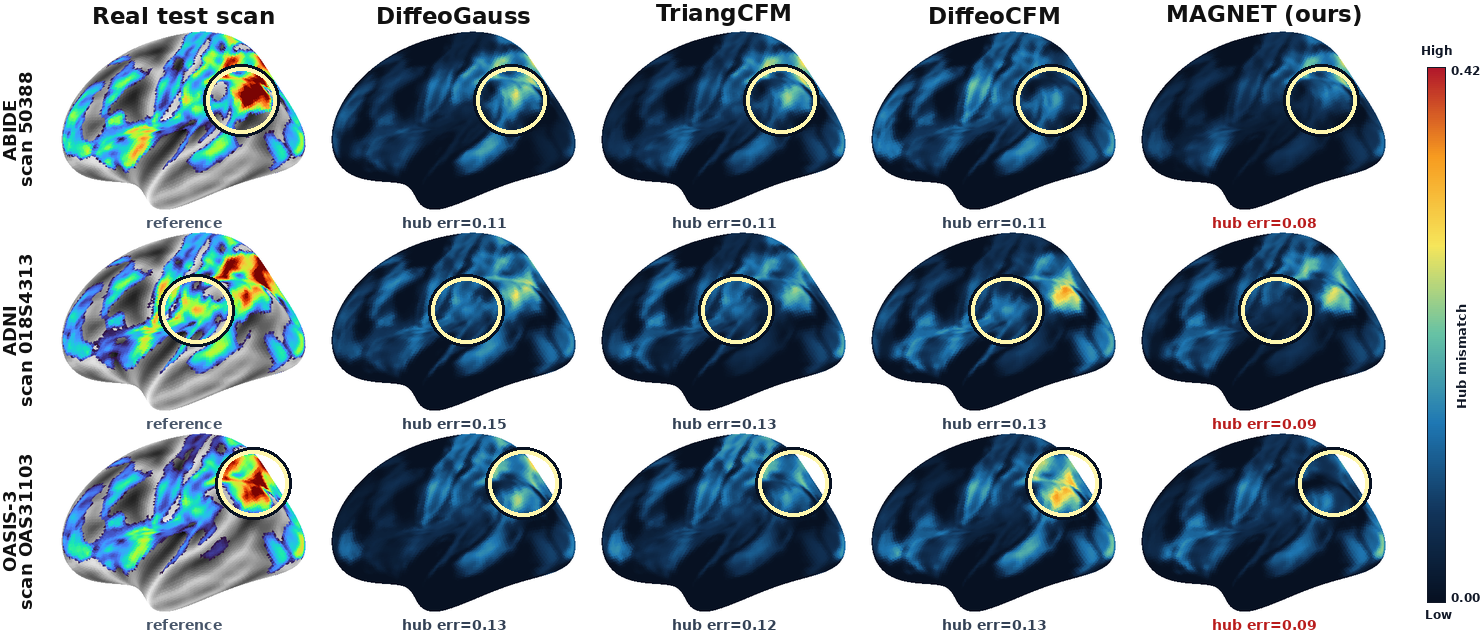
Cortical hub alignment
Spatial patterns across three independent cohorts.
Accepted at NeurIPS 2026
* Equal contribution
1 University at Buffalo, SUNY · 2 National Institutes of Health, United States · 3 POSTECH, South Korea
Valid correlation geometry is only the beginning. MAGNET generates class-conditional functional connectomes while preserving finer clinical structure.
Abstract
Functional brain connectome represents neural connectivity as a matrix of pairwise interactions between brain regions. Generation of functional connectomes is not only a question of validity; rather, having satisfied the constraints on the correlation matrix, the next step is to recover the class-conditional geometry buried under coarse labels. We propose MAGNET, a Manifold-Aware Graph Diffusion Network which uses a normalized-Cholesky representation of the manifold of correlation matrices that guarantees validity. MAGNET lifts noisy latent states into ROI-level region tokens and performs denoising with a relational inductive bias over brain atlas regions. To deal with structural problems induced by coarse labels, MAGNET employs class-anchored conditioning, amortized structural bridge, and relevance-preserving corruption. Across ABIDE, ADNI, and OASIS-3, MAGNET consistently achieves favorable results compared to previous manifold-aware approaches, demonstrating improvements of 7-21% in class-conditional fidelity (α,β-F1) across three cohorts and better sampling efficiency. Moreover, while training only with strict binary labels, MAGNET is capable of maintaining clinical heterogeneity through fine substructure of the connectomes in a zero-shot setting, improving subclass covariance alignment (λ-MSE) by over 30%. These results suggest that geometric validity is a necessary but insufficient condition for clinical utility in connectome synthesis. Moreover, efforts in making the diffusion denoising class-conditional manifold aware finds utility beyond the highly curved brain connectome generation as this is a critical problem in various general settings.
The approach
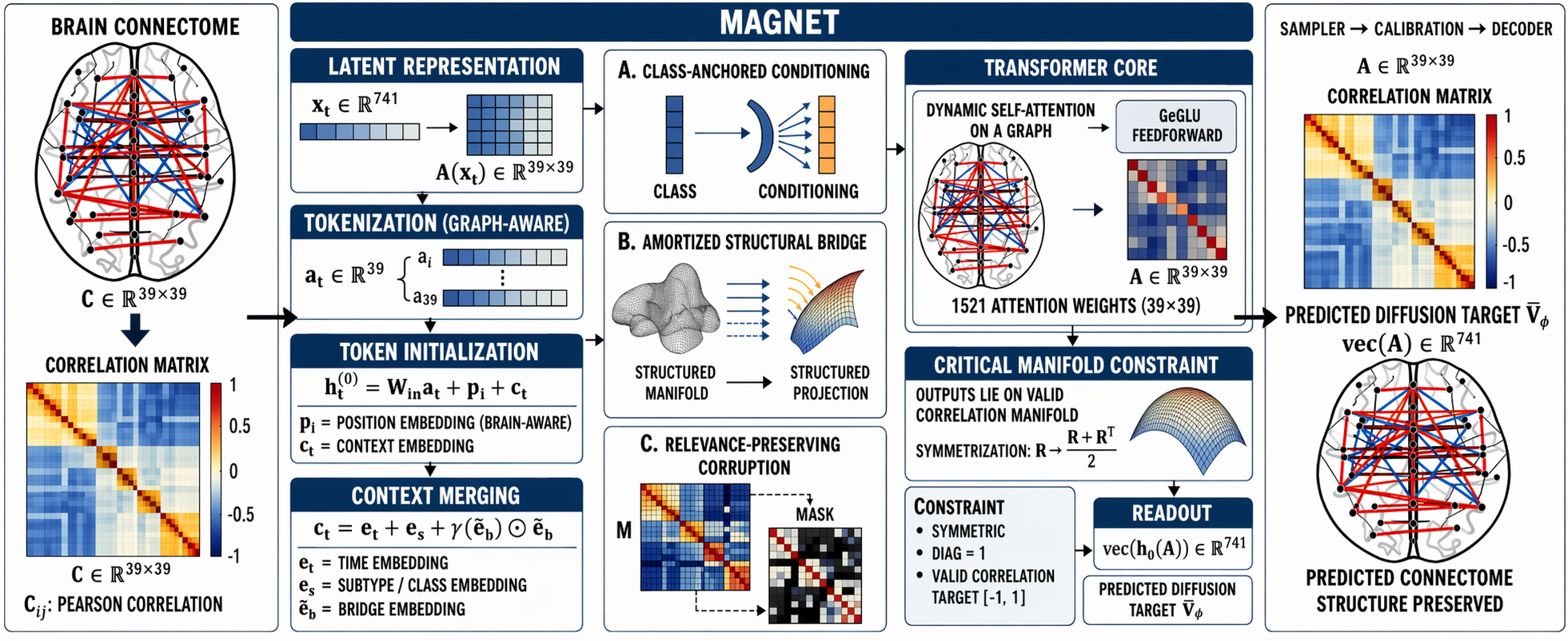
MAGNET treats a connectome as a structured point on the correlation-matrix manifold. A normalized-Cholesky coordinate preserves this geometry before ROI-level graph denoising, class-anchored conditioning, an amortized structural bridge, and relevance-preserving corruption shape the diffusion process.
For a correlation matrix C, MAGNET writes C = LLT and removes the diagonal scale from L before diffusing only through its strict lower triangle. With 39 MSDL regions this gives 741 latent coordinates. Decoding reconstructs the unit-lower-triangular factor, forms its Gram matrix, and renormalizes the diagonal, yielding a symmetric positive-definite correlation matrix with unit diagonal by construction.
 View full size
The evidence
Across ABIDE, ADNI, and OASIS-3, MAGNET is evaluated for class-conditional fidelity and preservation of finer connectome structure.
View full size
Spatial patterns across three independent cohorts.
 View full size
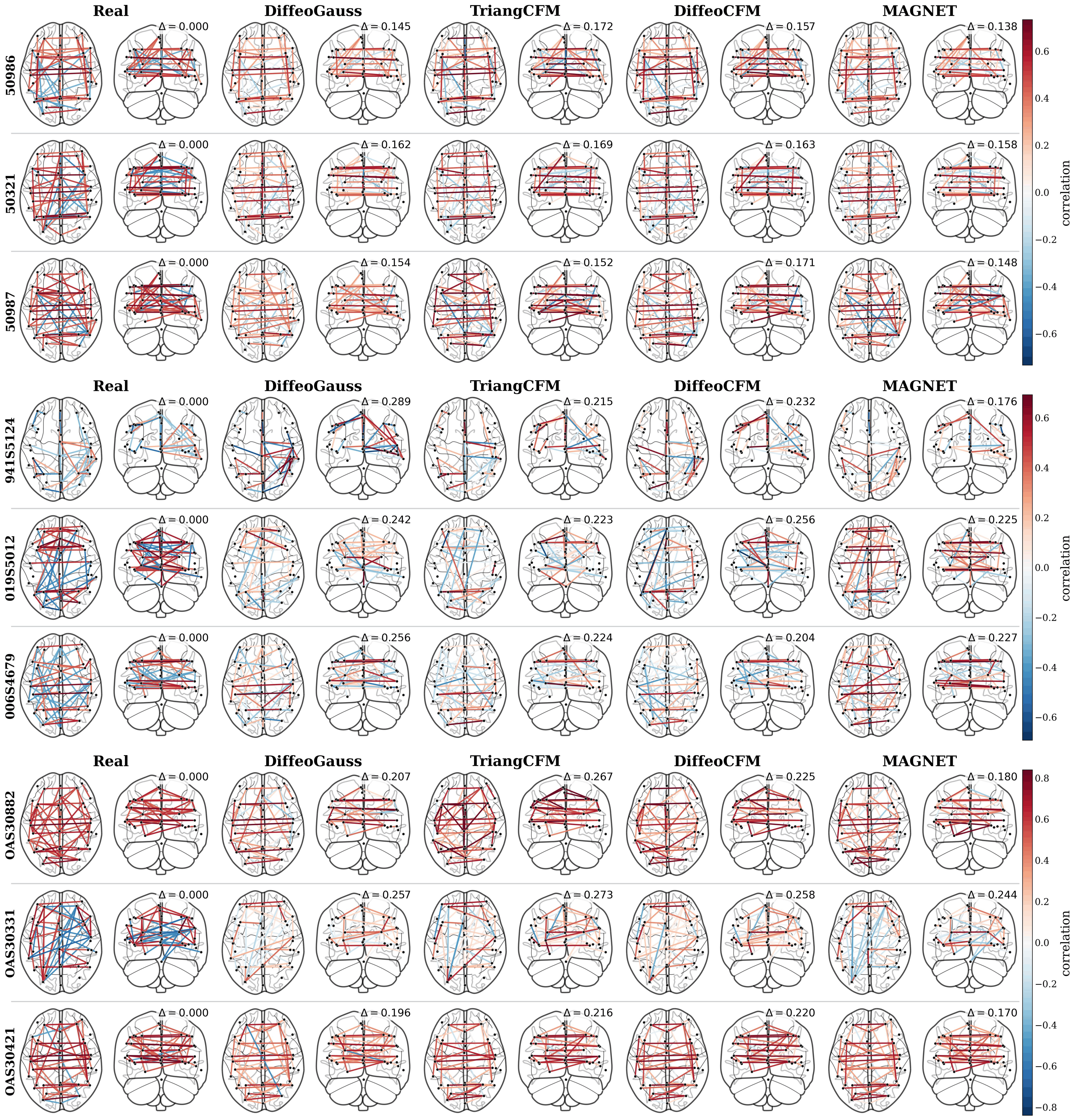
Real and generated connectivity patterns, shown together.